

I’m met with a lot of incredulity whenever I tell someone that I toyed with voting to leave the EU in 2016.
If you had to describe my general political persuasion you’d turn to words like liberal, centrist, globalist. I was young, liberal and at university - the exact demographic that the Brexit campaign essentially abandoned all hope on.
My pencil never wavered over leave in the ballot box, I changed my mind long before that.
But I had originally been in favour of a referendum (I wasn’t the only one - a referendum on Europe was the official policy of the Liberal Democrats from 2008, it was in their manifesto in 2010).
And when the referendum was announced, my first instinct was to vote leave. So - here’s what almost tempted me to the dark side, what eventually brought me back to my senses, and where it’s left me today.
My case for Brexit
1. The United States of Europe
America’s size has made it a global superpower, but it’s also created a swathe of social problems. For all its influence on the international stage; domestically there is rampant racism and rioting driven by poor race relations, there’s kids getting shot in schools with no political power to change it, and there are former reality TV stars in the highest echelons of power.
Change is almost impossible. The states, the supreme court, the Senate and the House - they clash and disagree until a new issue comes along to distract from the last.
And where there are central powers, they struggle to reconcile a country that has such distinct demographic, political and historical make-ups. How do you build a platform that speaks for the Deep South and New York? You don’t - the only way to win in America is to polarise.
The policy of the EU in 2015 was to be an “ever closer Union”. A central power governing over such a large area with cultural, economic and linguistic diversity is clearly unsustainable. That should be the lesson from the US (and European nations have even greater differences than American states). A United States of Europe would be a disaster.
This was my single biggest concern with the European Union: the policy was, in these exact terms, “ever-closer union”. There is no off-ramp.
2. The financial risk of remain
Part of being a nation state is the acceptance that we all pay in to support one another. A Londoner pays the pension of a Mancucian. The people in Hampshire know their tax money will sometimes be helping people in Lancashire recover from flooding, in the hope that it’ll flow the other way if disaster strikes them.
This is one of the foundational tenets of the nation state. Because we have shared values, culture and - most importantly - shared governance, we are all prepared to chip in to a shared point.
That governance point is the most important. The people in Hampshire don’t mind paying the people in Lancashire because they are subject to the same laws, the same taxes, the same benefits as all of us.
The deal collapses when you ask people to pay to prop up states where the rules are different. You see this unfairness emerge with devolution. A 22-year-old in England pays off his student loan, while paying taxes that mean a 22-year-old in Scotland goes to university for free. The social contract starts to collapse when it is one rule for me and one rule for thee, and I pay for both of us.
For as long as we were in the European Union, we would be paying towards territories governed in completely different ways from us. When the Greek government makes fiscally irresponsible decisions, the British, French and German taxpayers have to pick up the pieces.
It’s like splitting the bill equally when one of you was drinking champagne by the bottle.

In theory, Britain would be exempt from chipping in as non-members of the Eurozone. But in practice, Europe finds a way. During the Greek debt crisis, which should’ve been a Eurozone issue, the EU used a whole-EU European Financial Stabilisation Mechanism to provide a €7.18bn emergency bridge loan to Greece.
3. Sticking it to the man is fun
I, and probably the majority of Brexit voters and even campaigners, never thought leave would actually win. A Brexit vote offered a siphon for wider frustrations with politics and the country: David Cameron and the Tories seemed to be focused on the wrong things. Austerity seemed excessively cruel, and its architects excessively uncaring. Almost a decade on from the Great Recession, recovery was essentially shunted.
It was the same reason so many people voted Corbyn in 2017. Despite his significant flaws, millions voted for him just to stick it to the man (or, in 2017, the woman - Theresa May).
But Brexit was perhaps the ultimate illustration of why voting is not a game. Nobody thought they’d win - look at the ashen faces of Boris Johnson and Michael Gove upon learning that they’d got Brexit.
But some lessons are never learned. In the next election, many will vote for Reform - secretly hoping Nigel Farage is not the next Prime Minister. If he wins, many senior Reform figures will have the same aghast expression as Johnson and Gove, in the wake of the referendum.
My case for Remain
There were four reasons I ended up voting to stay in the EU.
1. Free movement is great
If you like the idea of one day living or working in Spain, EU membership made that a much easier prospect. Today, you are looking at visa costs in the thousands of pounds. It’s not prohibitive, but it’s no longer easy.
Of course, concerns around immigration were understandable. But leaving the EU to reduce immigration was trying to fix a broken door by taking a hammer to your window.
European immigrants were net contributors to our economy. By leaving the EU, we’ve reduced their number significantly. And we’ve filled the void with record numbers of non-EU immigrants who, on average, cost Britain more than they contribute. And integration is even more challenging when people are coming from thousands of miles away, rather than hundreds.
Not to mention, leaving the EU created the small boats crisis: terminating our previous returns agreement with France.
2. Cameron’s renegotiation was pretty good!
Maybe I’m the only person in Britain who thinks this, but I thought David Cameron did a pretty good job renegotiating our relationship with the EU, and I’d actually cite it as one of the main reasons I voted remain.
Firstly, he opted us out of ever-closer union. That rules Britain out of the United States of Europe, and sets a clear direction for the nature of the future relationship.
The renegotiation explicitly confirmed that non-members of the Eurozone will not be responsible for emergency and crisis measures: opting Britain out of picking up the tab for the reckless spending of other nations.
Of course it wasn’t perfect, and in some ways it proved that the continent was out for its own interests at the expense of ours, but it did build a framework for a productive future relationship. Staying in the EU under this remodelled relationship gave us a chance to be lawmakers while retaining British independence.
Today, we are more likely to be lawtakers: still de facto subject to much of the regulation crafted by the EU, with no say in it whatsoever.
3. Europe is a useful safety net
In very recent history, a major European state democratically elected a leader who tore down the guardrails, amassed absolute power, then committed one of the worst atrocities in all of human history in the form of the Holocaust.
I know everyone groans when you bring up the Nazis, but it is really not outside of the realm of possibility that a country might do this again. It could be Britain.
Intertwining our governing with Europe (both through the EU but also through other mechanisms, like the ECHR) acts to restrain the worst impulses of a would-be despot, with mechanisms to prevent overreach, unfairness, immorality. If a madman gets into Number 10, we hope our courts and our parliament will stop them. Europe is the backstop.
And yes, that impinges on our national sovereignty. But that’s a valuable trade-off.
4. The campaign didn’t reflect my values
Maybe I’m woke and lame, but as a rule of thumb I try not to vote for people I think are nasty, racist, opportunists. I think that the job of politicians and politics should be to unite people, work for the whole nation and emphasise our points of similarity. I don’t support the populist strategy of throwing hand grenades, creating culture wars, turning families against each other.
The strategy of Vote Leave (and Reform, today) was to make people angry, to heighten their disillusion with the state, to bring out their worst impulses.
I’m sorry to say: when you play stupid games, you win stupid prizes. MPs get killed, there is more violence, people are attacked and killed for what they believe.
I couldn’t vote for a campaign that I felt was showing the very worst of the country. Deliberately sowing intolerance, deliberately creating anger and fear.
You do not run a country by drawing a line down the middle of it and saying it’s us v them. In fact, history tells us that that’s a quickfire way to destroy a country.
So … now what?
1. And stay out!
If your teenage years teach you anything, it’s that you should never get back with your ex.
I fundamentally disagree with the contingent that want to rejoin the European Union. There is certainly a need for a redefined, closer relationship with the continent. But that relationship cannot be within the existing frameworks of the EU. Any attempt to re-enter would be a dereliction of democracy, and it’d leave our standing on the global stage completely shot.
Europe was hardly magnanimous in the divorce (the debacle over vaccines was a particular low point), and showed their true colours in the negotiations. If we return, cap in hand, we’ll invite them to treat Britain as a permanent second-class member.
2. The opportunity of Brexit is cutting red tape - and we’re not doing it
Every time you log onto a website and see a banner asking you to accept cookies, you should curse the European Union’s overzealous regulations. It’s the reason we get new AI models after the rest of the world, the reason bottle caps are now nonsensically tethered to bottles, the reason you don’t get free mini toiletries in European hotels.
I’m all in favour of using the hand of government to sway the free market, but Europe has moved from liberal paternalism to outright nannying. Britain has the opportunity to slash some of the nonsense, improving things for consumers and the market alike.
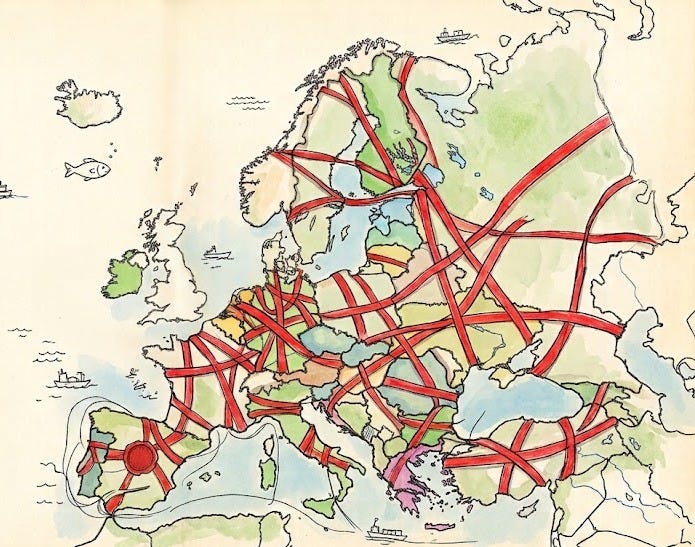
Yet, for the most part, we choose not to. We’ve kept most EU regulations exactly as they are. We need, as Rishi Sunak proposed, a bonfire of EU regulations - to make the UK the home of innovation in the European continent: an oasis for business and consumers in the innovation desert of Brussels bureaucracy.
3. Let’s never do this again
Turns out, referendums are terrible.
Have you ever seen those viral videos where an influencer offers someone either $10 or the mystery box? The mystery box could contain thousands of dollars, a new iPhone, a free holiday … people naturally take the mystery box.
The EU Referendum offered voters the choice between economic stability, or the mystery box.
If we were to re-run the EU referendum, we should have a leave-supporting contingent go out to Europe and negotiate - at the very least - the framework of a viable exit deal. That would’ve given us two fleshed out options to put to the public, rather than remain v the mystery box.
But much more importantly, we should simply never do a referendum again. In a representative democracy, we vote for the people we think are smart enough and aligned enough with our values to represent us effectively. Then we put all of them in a room and ask them to make the big decisions, so we don’t have to.
If a majority of our representatives can’t agree on an effective way to do something, then nothing should happen. This is the Parliamentary system. Adding in a public mandate via a referendum is like tossing a grenade into the system.
That’s what caused the stasis for almost 5 years, the surge in government spending on civil servants, the ridiculous conveyor belt of Prime Ministers.
Yes, referendums give you quick and radical results. But democracy works not in spite of being slow and boring - but because of it. The system should default to inaction until a workable plan is formed (and, by the way, that’s exactly what is happening with assisted dying: and it’s a good thing).
I’m not a particularly strong remainer, and I think we can (and should) build a successful future outside of the EU. But the lesson from Brexit, more than any other, is that we should never do a referendum again.
I think the problem with a referendum is that you are asking people who have no understanding of the intricate and long term implications of a decision (and I include myself in that group) to make a decision. Because of this lack of understanding, they make a decision based on a headline or slogan that turns out to be fundamentally flawed - "£350m a week to the EU, let's fund the NHS instead" - Turns out when you stop paying the subscription, you stop receiving the rebates and benefits. "Take back control" of our borders. Who knew when you restrict legal access to immigration the number of people trying to enter the country doesn't magically reduce, people just find other ways to try to enter. There may be a place for referendums to address simple issues, but for socio-economic decisions which will affect generations to come, that is not appropriate.