On Wednesday, the Chancellor John Healey will deliver his first Budget. He has done a militant job of keeping his measures away from prying eyes, leaving most of us without a clear sense of what to expect.
There will be lots of money for devolution, some measures for entrepreneurs, and he’ll respect the fiscal rules and the manifesto commitment on taxation. He really needs to increase spending on defence - lest he look like the world’s biggest hypocrite.
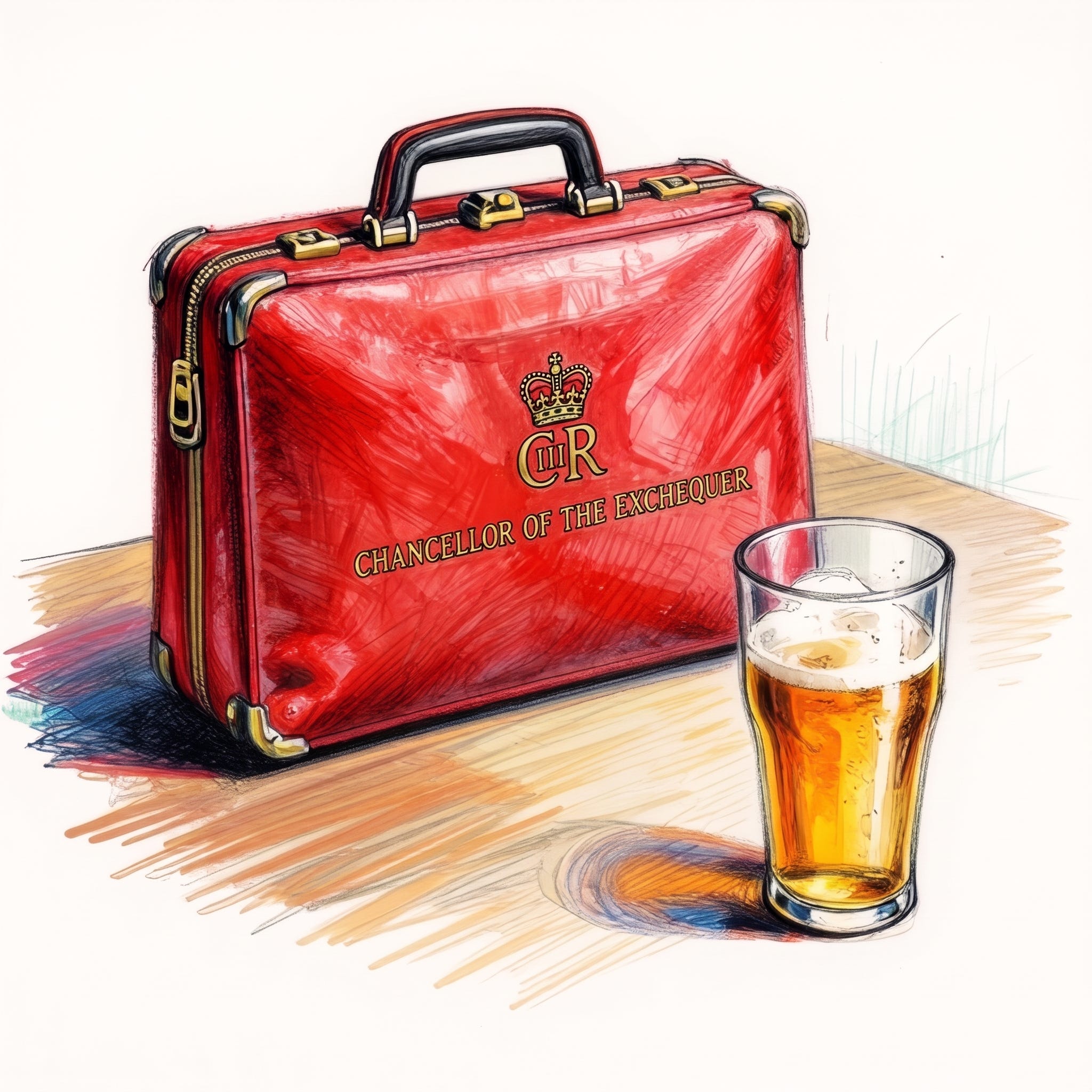
There are also some rumours that he might take advantage of the bizarre rule that lets a Chancellor deliver their Budget with an alcoholic drink in hand. It’d be a useful gimmick if he decides to, as has been rumoured, cut duties on pubs.
Central to the Burnham project is what he calls ‘breathing space’, but what his opponents might call ‘micro-fixes’. Very small, very cheap measures that marginally help voters save pennies (in many cases, literal pennies). It is proving popular, and there is an extent to which it is overdue - it is the small irritants that build up and create the image of a broken state.
But I suspect that the government is staring down the barrel of at least one major crisis, which will make the micro-fixes of the Budget look like small change.
Predicting anything is a fool’s game, but geopolitical shocks do have a way of coming around every seven or so years. The dot-com crash in the 90s, 9/11 in 2001, the Great Recession in 2008, Brexit/Trump in 2016, COVID in 2020 (despite often being described as ‘once-in-a-lifetime’, the average person - it seems - will live through about 10).
In other words, we’re overdue a crisis.
So when John Healey delivers his Budget, and bungs a few million here and a few million there, I can’t help but be reminded of Rishi Sunak’s first Budget. COVID support got just a single bullet point in a wider list of tax and spend measures - and he dedicated £12bn to supporting the pandemic response. At the time, it was a momentous amount. But just weeks later, it would look like a rounding error as he committed further hundreds of billions of spending to pay the wages of millions of Brits.
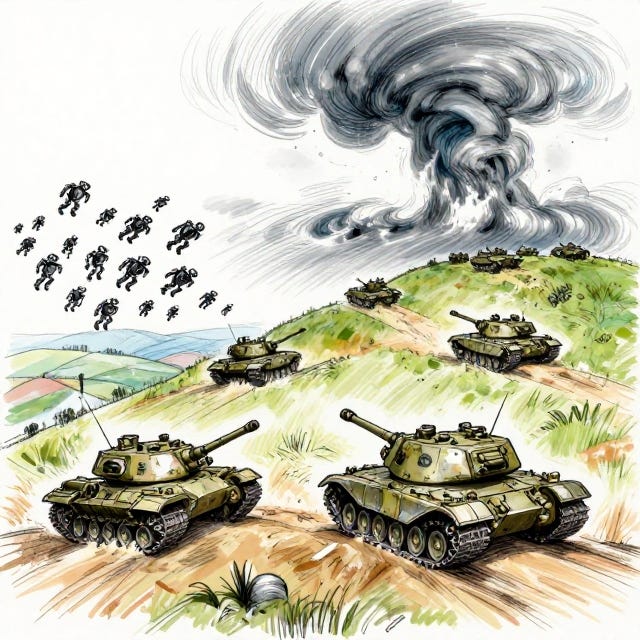
So what will the next crisis be? Weather, war or work. In the best case scenario, it will be one of those three. In a worst case scenario, it will be some confluence of all three.
Weather
First, weather. The term ‘global warming’ has largely been misunderstood to mean that the weather will get consistently hotter. The truth (and the reason ‘climate change’ has become the more popular descriptor) is that the weather will get wilder. Even in Britain, which will feel the effects most mildly, we are already seeing more heatwaves and droughts, and more flooding.
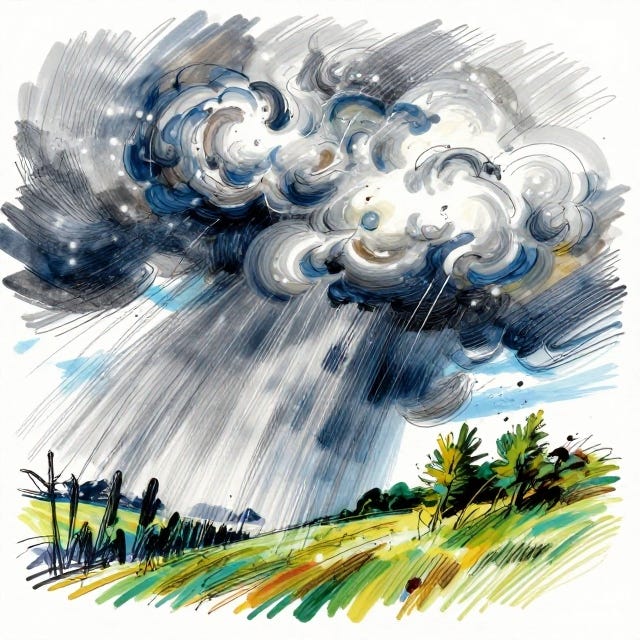
This winter, you combine these already unpredictable weather patterns with the incoming ‘El Nino’ weather system. El Nino is a naturally occurring weather system that raises global temperatures every two to seven years. This year’s el Nino is expected to be the most severe ever recorded.
It has not even begun in earnest, and the effects are already being felt. Already wildfires have raged in Indonesia, there have been 12 hurricanes in the eastern Pacific, India has seen 25% less rainfall during its monsoon season.
Things will get much, much more dramatic - in Taiwan, hundreds of people took part in a national emergency drill to simulate power and water disruption. In China, the government has legislated to force employers to protect their workers from extreme weather. Sri Lanka is bringing huge tankers of water in to fill ponds and closing tourist sites in an attempt to preserve water, as the country faces its worst drought in a decade.
It is undoubtedly the case that thousands and thousands of people globally will die.
In Britain, it is expected we will be shielded from the most extreme weather events. However, that is not guaranteed - unpredictable weather is, by its nature, unpredictable.
What we will be affected by, however, is the effect of this weather on our food supply chains. Half of the food we eat is imported - and 80% of the fruit and veg. In a best case scenario, an extreme el Nino event could drive up food prices. In a worst case scenario, we could see empty supermarket shelves.
War
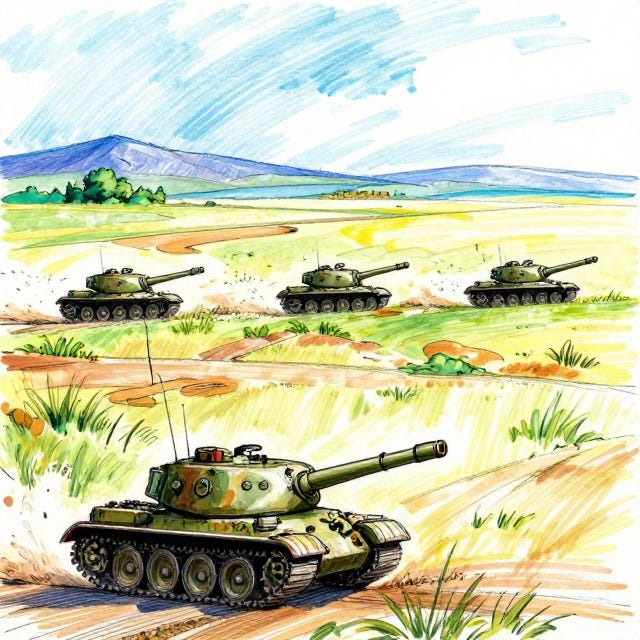
The world is already at war, and we are a hair-trigger away from any one of these wars getting worse.
China, Russia and Iran form an axis of ‘chaos agents’ whose goal is to drive international disorder, destabilise the West and disrupt the liberal, democratic status-quo. It is entirely plausible they will aid, abet, encourage and arm other nations to create distracting skirmishes around the world.
It is in their interest to create further tensions in the Korean peninsula, to aggravate Argentina over the Falkland Islands, to unravel attempts at peace in Ukraine, Iran and Israel.
As I have been writing for the last 18 months, China will almost certainly invade Taiwan sooner or later. The world was caught off guard when Russia invaded Ukraine, and we are at risk of the same thing happening with Taiwan. We must decide now what support we will give the Taiwanese people to fend off an invasion.
This would be extremely consequential for the global economy. Taiwan controls 90% of the production of the world’s semiconductors: the vital hardware that powers AI. If the Chinese Communist Party controls this production line, we put the fate of the Western world in their hands.
But it is not just traditional warfare we need to worry about.
Last week, OpenAI and Google AI tools discovered major security vulnerabilities in a programming language powering most of the web. There was a scramble to close the loopholes - but not before millions and millions of attempts were made to attack the online services we use and rely on everyday.
This is a sign of what is to come - a new age of cyberwarfare, where governments, terrorists and even lone-wolf hackers can inflict relentless chaos through the power of AI. AI can discover security vulnerabilities and then, by deploying a ‘swarm’ of AI agents - dedicate seemingly unlimited resources to hitting those vulnerabilities until they break in.
I expect the coming months will see relentless hacks in ways none of us expect. Last month, hackers hiked the temperature in French supermarkets’ fridges and freezers - causing millions of euros worth of food to be spoiled overnight.
In Britain, we have clear vulnerabilities that adversaries could target with the help of AI: the grid, the internet, food supplies.
Work
Cyberwarfare is not the only chaos that AI will inflict.
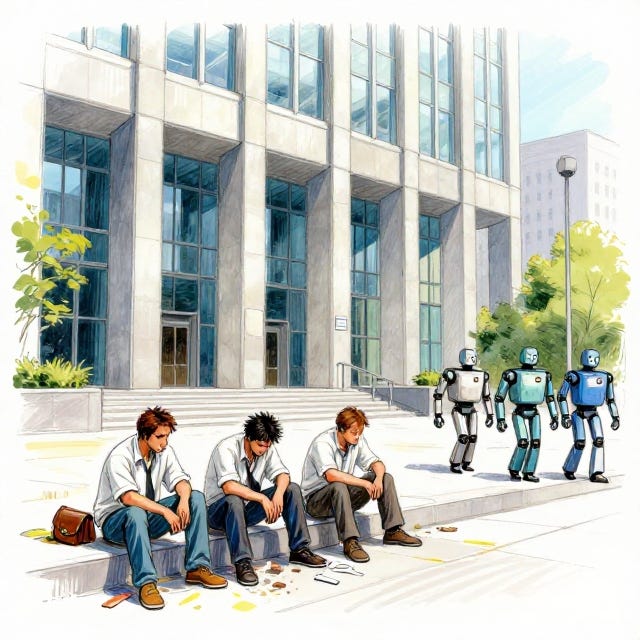
The government has raised the cost of hiring at the exact same moment as new technology made hiring optional. For desk-based jobs, there is essentially no point in hiring an entry-level worker, as AI can do the job just as well or better in many cases.
The oft-touted phrase, ‘AI will destroy some jobs but it will create new ones’ is not bearing out in reality. Even the most well-intentioned employers simply cannot find work that AI can’t do better than a grad or school-leaver.
This is a total catastrophe for young people. But it’s also a sign of what’s to come. Entry-level desk jobs are the first casualty of AI. Middle managers are next, and soon it will come for most of us whose primary job involves typing. Those jobs account for more than 80% of the UK’s GDP.
Faced with this meteoric crisis of work barrelling towards us, the government keeps reaching for a lever labelled ‘AI skills’. The whole point of AI is that it requires very little skill to use.
Instead, our economy must be upended. Trades and case-based roles - which have been neglected for at least the last decade - will now need to become mainstay employers. We will almost certainly need some radical solution - like a Universal Basic Income.
The major AI firms are already preparing for this possibility, with Elon Musk and Anthropic both putting aside large chunks of their company values for ‘social good’.
None of this is doomerism - I think we’re living through the most exciting time in human history and AI will create perhaps the biggest ever uplift in the quality of life. But in the short-term, it is going to cause pain. We need something to mitigate that.
At the despatch box
On Wednesday, John Healey will undoubtedly talk about the price of a pint or a bus ticket as he delivers his Budget.
Like the politicians in the movie “Don’t Look Up”, he’ll ignore the meteors that are plummeting towards him.
But there are solutions.
First, energy independence. Britain could have cheap, abundant energy produced at home - cutting off our dependence from any foreign actor or market shocks. Weather disruption, war and cyberattacks can all affect the importation of energy: not if we produce our own energy at home.
Second, lab grown meat. The food supply chain is fundamentally broken and leaves us especially vulnerable. The government must act fast to approve and back lab grown meat as a way to produce plentiful food safely and sustainably.
Third, a hike in defence spending. In a world on the precipice, the government must prioritise defence spending. Defence procurement should be greatly improved at the same time - ensuring effective technologies are being purchased and used in the British military. We need a major investment, in particular, in the weaponry that has proven so effective for Ukraine: such as drones.
Fourth, greater powers for the AI Safety Institute. The world is in a race to the bottom on AI, leaving all of us vulnerable to the effects of unsafe, unaligned AI systems. Britain has failed to lead on development of frontier AI. But that puts us in a prime position to lead on safety. We are uniquely placed to get America and China around the table to set the guardrails that keep us safe.
Fifth, a trial of Universal Basic Income - paid for by a tax on AI usage. If AI leads to mass unemployment, we need an alternative. Over the last 200 years, there has been a consistent pattern: people work less hours, doing easier jobs, for more money. That pattern will almost certainly continue, but we need radical ideas from the government to ease the pain of the transition. I have laid out how this would work in a previous post.
Radical times need radical ideas. Nobody was prepared for COVID. Nobody was prepared for the Recession. Nobody was prepared for Ukraine.
We can be prepared for what is to come. But will we be?