

This month, Primary Schools up and down the country will be putting on the same show. Houses will put out models of the same scene. And churches will tell their congregations the same story.
The Nativity is the foundation of the world’s largest religion, and probably the best known story ever told.
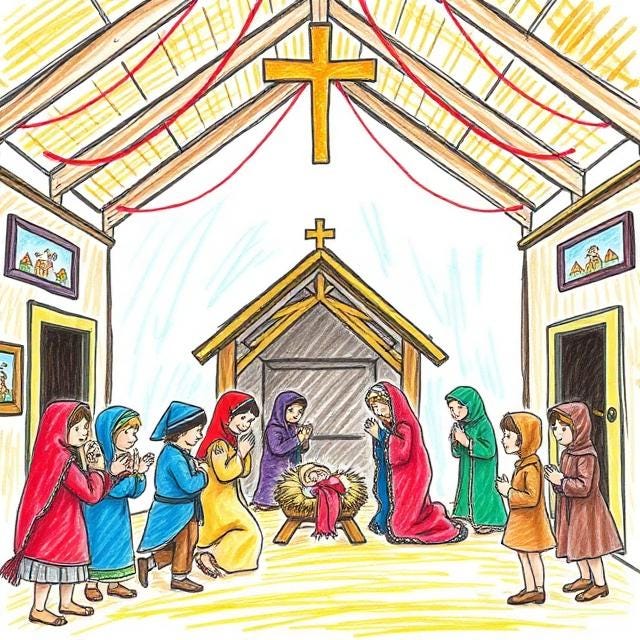
The problem? The evidence is overwhelming that it isn’t true. In the true Christmas spirit, I’m going to set out the evidence against the Christmas story - but also why accepting it’s false is not irreconcilable with holding Christian faith (i.e. why you can still be a Christian but accept the birth narrative is not true).
So let’s start with the basics. The Bible is not one book: it’s a collection of books. The Old Testament was a collection of scriptures and writings that existed when Jesus was born, and that he referred to. The New Testament is also a collection of writings, written after the death of Jesus. Nearly 400 years later, those writings would be compiled and ordered to form the New Testament (with some of the books chucked out).
The four gospels - Matthew, Mark, Luke and John - are essentially four biographies of Jesus. They were written several decades after the death of Jesus. Confusingly, most scholars agree they were not authored by the namesake disciples, they were written by some anonymous, well-educated writers who had heard the stories passed down orally.
Historians generally agree that the Gospels provide a fairly accurate account of Jesus’ life in most regards but one: his birth.
The evidence against the birth story
For a start, it’s a little bizarre that the birth story is only told in two of the four Gospels of the Bible - Matthew and Luke. The other two either didn’t know it, or didn’t think it was worth mentioning (or perhaps had heard it, but felt it was unlikely to be true).
Even between them, they can’t agree on almost a single element of the story. Luke says Mary and Joseph travelled to Bethlehem for a census - Matthew says they lived there. Luke says shepherds visited the baby Jesus, Matthew says wise men. Matthew says King Herod killed all the babies in fear that Jesus was a threat to his authority. Luke says - nothing about that.
In terms of the historicity of the story, things just don’t add up. Both Matthew and Luke claim that Jesus was born during the reign of King Herod. Herod died in 4 BC, but the census that Luke claimed Mary and Joseph were travelling for did not happen until a decade later.
Not to mention, Roman census-taking did not involve travelling to your birthplace (why would it?).
It’s also incredibly strange that Jesus was supposedly born in these miraculous circumstances, and yet nobody ever brings them up again for the rest of his life. In Mark, his own parents think he has lost his mind (if angels had descended to them during Jesus’ birth, they surely would accept he was the son of God). Nobody at any point says, “aren’t you the guy that was born to a virgin?”.
The birth narratives stand alone, like they were plugged in after the book was written. When you write an essay, you often write the introduction last because it’s easier to write once you’ve figured out your argument and structure. It’s possible that the gospel writers did the same thing.
Why create a birth narrative in the first place?
If we accept the birth story is an invention, why did the authors of Matthew and Luke feel the need to invent it?
Matthew was written for a Jewish audience, and aimed to convince a Jewish reader that Jesus is the son of God, as prophesied in the Old Testament. Matthew constantly refers back to the Old Testament and how Jesus’ life matches what was predicted. Remember, the principle difference between Judaism and Christianity is that Christians believe Jesus has come and fulfilled the Old Testament promise of the coming of the Son of God. Jews believe that day is yet to come, and Jesus didn’t meet the criteria.
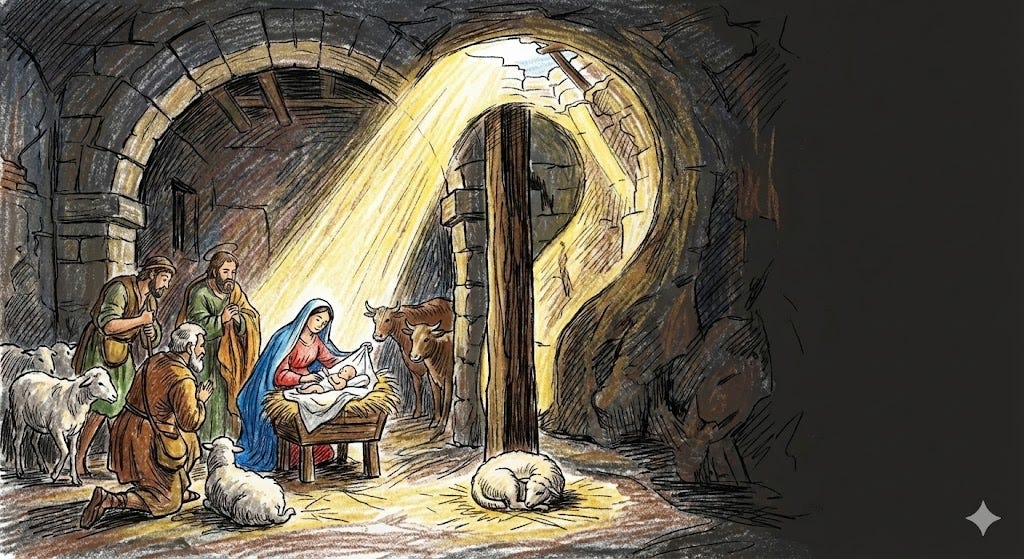
It’s possible that the birth story was an invention to further convince Jewish citizens of the Roman Empire that Jesus did fulfil the criteria.
And the authors might not have set out to make it up. If you genuinely believed Jesus was fulfilling the Old Testament prophecy, you’d just safely assume he also fulfilled the parts about birth, so craft them together into a story.
Matthew’s author was so desperate to show Jesus fulfilled prophecy, he even made up a prophecy: “And he went and lived in a town called Nazareth. So was fulfilled what was said through the prophets, that he would be called a Nazarene.” Except none of the prophets said Jesus would be called a Nazarene, it seems Matthew just imagined that.
Ancient biographies
In Ancient biography, it was not unusual to mix reality with mythology. The closest equivalent I can think of in a modern biography might be metaphor. When we say a politician was stabbed in the back, or massacred their cabinet, or anything else - we understand there was no literal murder involved. In 10,000 years people might read these biographies and think politics was a deadly game. In the same way, an ancient reader of a biography would expect to see fantastical mythology alongside historically accurate details: they are, like metaphor, a device to aid understanding.
The message of the Gospels is that Jesus fulfilled the prophecy of the Old Testament, and that in his human form, lived a life alongside the humble and poor. What’s more humble than being born beside a donkey?
Luke’s gospel, in particular, tells the story of Jesus as a servant and friend to the humble and needy. The birth story is almost a metaphor to elevate this point: not historical fact, but illustrative fiction.
We still get it wrong
But even if it were true, most of what we think we know about the story does not line up with the stories in the Bible.
It feels like there is this whole lore around the Nativity: it’s a story that’s filled countless movies, books and shows. You kind of imagine that, like a lot of historical tales, there’s even more detail that gets left out for retellings.
Yet the source material, the actual Biblical telling of the birth, is less than 3000 words. Harry Potter and the Philosopher’s Stone is 76,000 words. This essay is more than 2000 words! It’s a tiny, tiny story and most school Nativities are actually filling in gaps, rather than leaving details out.
But given it is so short and that it’s the most famous story in the world, that we’d know it pretty well: but it turns out we don’t know it at all.
So, here’s a quick quiz to see how well you know the Nativity story:
How did Mary and Joseph travel to Bethlehem?
If you answered, ‘on a donkey’, I’m afraid neither book mentions that. And Matthew says they didn’t even travel to Bethlehem, they lived there.
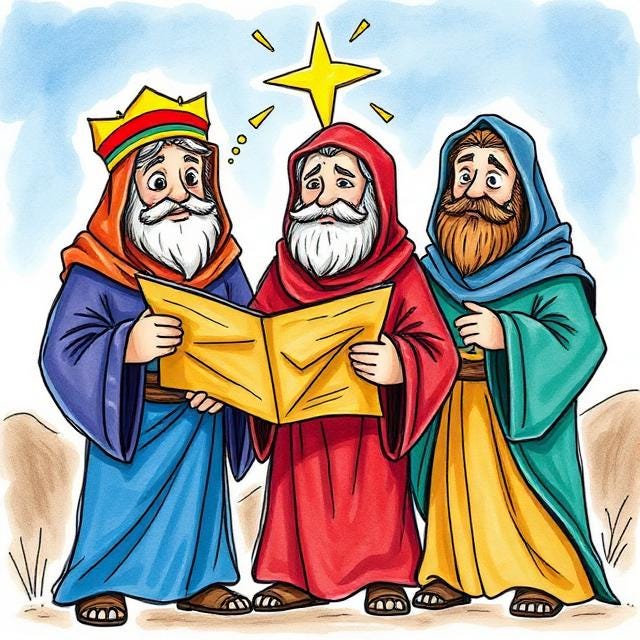
How many Wise Men visit Jesus?
It’s not 3. Matthew does not give a number. They brought three gifts, so early artists probably thought it easiest to paint 3 guys with a gift each.
Did Mary and Joseph go door-to-door at inns?
No, that never comes up. In fact, Mary and Joseph wouldn’t have stayed at an inn, they would’ve stayed with family or friends. The idea of an inn comes from a strange translation choice from the King James Bible, since corrected.
Was Jesus born in a stable?
Neither account mentions a stable - in fact, Matthew specifies Jesus was born in a “house”. The actual story seems to indicate that Mary and Joseph are staying at a relatives’ house and the guest room was occupied. There are no animals in the story, no stable - the only thing that indicates something strange is that Jesus was placed in a manger. But traditional Judean homes would bring the animals into the lower floors at night, hence the manger. Or maybe Mary and Joseph’s hosts just rummaged around for anything suitable to place a baby in. The stable myth propagated, again, because of Western artist depictions of the scene.
Does it even matter if it’s not true?
So the Nativity story is almost certainly an invention. But what’s the harm in juicing up his biography? Particularly if it helps illustrate the wider message.
After all, it’s nothing we don’t do with other historical figures: in movies and books we completely invent dialogue and sub-plots to make our heroes appear more heroic and just.
I think you can accept that Jesus was a significant person in the history of the Earth, who gave us useful teachings about morality and compassion, and yet we’re sketchy on the exact details of his life two thousand years ago. I think you could even accept he was the Son of God and Messiah, but that the fallible humans who recounted his life didn’t get everything right, or used narrative devices to better tell the story.
After all, for just about all of human history, religion has been a device for explaining things we don’t understand.
30,000 years ago, religion had to explain why the sun appeared in the morning and disappeared at night. Today, religion answers questions we cannot: what was the uncaused cause for the creation of the universe? Religion calls it ‘God’. What happens to consciousness after death? Religion says it transcends into an afterlife. Why do we have morality even when it’s often maladaptive to our survival? Religion says it’s our soul.
And this isn’t so crazy - science does the exact same thing. Why do some galaxies behave as if they’re full of mass when we can’t see anything? Not sure, but let’s just call it dark matter. How is this particle existing in two states at once when we’re not looking? No idea, let’s just call it quantum. How can electrochemical activity in the brain create subjective experience? No clue - just call it consciousness.
Inventing a name for concepts we don’t understand helps us make sense of the world and the universe. For the biggest unanswered questions about the universe, we probably don’t even have the words or the imagination to craft an explanation. Just like how prehistoric humans couldn’t begin to imagine or describe a vast plane of nothingness in which a giant ball just floated, and they lived on that ball.
There are lots of things we simply don’t know. The birth of Jesus is one of them. A story can be a useful way of filling that gap.